Balayage vs Ombré: Complete Guide to Choosing the Perfect Hair Coloring Technique
Discover the essential differences between balayage and ombré, learn which technique suits your hair type and lifestyle, and master maintaining your perfect color with our complete expert guide.
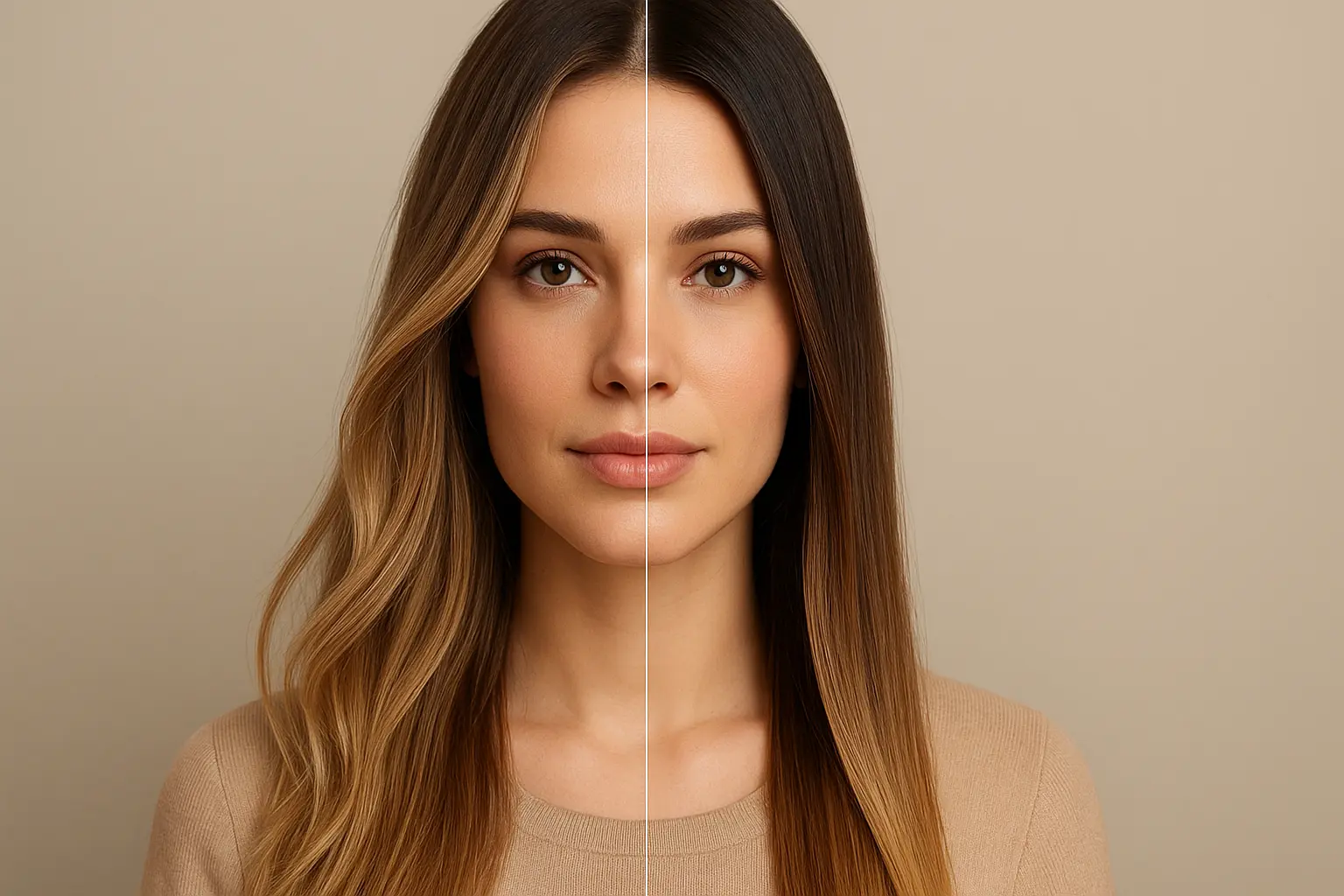
Choosing between balayage and ombré can seem confusing when both techniques promise stunning looks with graduated colors. Although many people use these terms interchangeably, balayage and ombré are completely different hair coloring techniques, each with unique characteristics in application, results, and maintenance. In this complete guide, we'll explore everything you need to know to make the perfect choice for your hair.
Table of Contents
What are balayage and ombré?
Definition of Balayage
The term balayage comes from the French word "balayer," meaning "to sweep." This freehand coloring technique was developed in France in the 1970s and revolutionized the world of hair coloring. Unlike traditional techniques using foil or caps, balayage is applied directly to the hair with brush strokes that mimic the natural effect of the sun.
The great advantage of balayage is its naturalness and personalization. The hairdresser literally paints the hair by hand, creating a smooth and harmonious gradient that respects the base color and adds depth and dimension. The result is an illuminated, natural effect, as if you've spent a vacation in the sun.
- Technique: Freehand application with brush, without foil sheets
- Effect: Smooth and natural transition from root to tips
- Result: Multi-dimensional and illuminated appearance
- Growth: Very discreet, without demarcated lines at the root
- Personalization: Fully adaptable to face shape and hair texture
Definition of Ombré
Ombré (from the French "ombrer," meaning "to shade") is a technique that creates a more dramatic and visible transition between two colors. Typically, it's characterized by darker roots that gradually become lighter at the tips, creating a more pronounced and intentional gradient effect.
Unlike balayage, ombré doesn't seek to mimic the natural effect of the sun. It's a bold and contemporary style choice that celebrates the contrast between colors. The result is more graphic, more defined, perfect for those who want a visible and striking transformation without dyeing all their hair.
- Technique: Horizontal application with defined transition between colors
- Effect: More marked contrast between root and tips
- Result: More dramatic and statement visual
- Growth: More visible, but still with reduced maintenance
- Style: Bold, modern and impactful
Other Related Techniques: Sombré, Babylights and Highlights
Besides balayage and ombré, there are other coloring techniques worth knowing:
- Sombré: A softer version of ombré ("soft ombré"), with an even more subtle transition between colors. Ideal for those who want the ombré effect but with a more discreet result.
- Babylights: Very fine and delicate highlights that mimic the natural lights in children's hair. Can be combined with balayage for an even more natural effect.
- Traditional highlights: Uniform highlights applied with cap or foil, evenly distributed throughout the hair. More uniform result but less natural than balayage.
Technical Comparison: Application, Results and Maintenance
Salon Application: Time, Process and Amount of Color
Balayage: Applying a full balayage typically takes between 2 to 4 hours, depending on hair length and thickness. The process involves freehand painting of strategic hair sections, focusing on areas that would naturally catch more sunlight. The hairdresser works with artistic precision, creating a harmonious blend of tones.
Ombré: Ombré can be faster, taking between 1.5 to 3 hours. The technique involves applying bleach or color to a defined horizontal zone, usually from the middle of the hair to the tips. The process is more direct, but requires experience to create a smooth and not abrupt transition.
Visual Result: Contrast, Naturalness and Face Adaptation
Balayage: Offers an extremely natural and personalized result. Colors are strategically placed to frame the face, add movement and create depth. The effect is subtle, luminous and multi-dimensional. Perfect for those who want to lighten their hair without looking like they've been to the hairdresser.
Ombré: Creates a more dramatic and intentional look. The contrast between dark root and light tips is more evident, making a style statement. It's ideal for those who like bolder looks and want a visible change. Ombré can also be adapted with different contrast intensities.
Maintenance Over Time: Touch-ups, Cost and Hair Damage
Balayage: One of the biggest advantages of balayage is low maintenance. As there are no defined lines at the root, growth is very discreet. Touch-ups are only necessary every 3 to 6 months, depending on hair growth speed and desired contrast. This makes balayage an economical option in the long term.
Ombré: Ombré also offers good durability, with touch-ups needed every 2 to 4 months. Although growth is more visible than balayage, it remains much more practical than traditional highlights. Maintenance focused mainly on the transition zone and tips can help refresh the look.
Estimated Costs in Lisbon and Portugal
Prices vary according to salon, professional and hair length. At Valentina Hair Concept in Lisbon, we work with high-quality products and specialized techniques to ensure the best results:
- Full balayage: Between €120 and €250, depending on length and complexity
- Ombré: Between €100 and €220
- Sombré: Between €130 and €240
- Balayage touch-ups: Between €80 and €150 (every 3-6 months)
- Ombré touch-ups: Between €70 and €130 (every 2-4 months)
- Post-coloring treatments: Between €25 and €60 (recommended to maintain hair health)
Quick Comparison: Balayage vs Ombré
| Characteristic | Balayage | Ombré |
|---|---|---|
| Technique | Freehand painting | Horizontal application |
| Effect | Natural and sun-kissed | Dramatic and contrasting |
| Transition | Smooth and diffused | More defined |
| Salon time | 2-4 hours | 1.5-3 hours |
| Maintenance | Every 3-6 months | Every 2-4 months |
| Growth | Very discreet | More visible |
| Initial cost | €120-€250 | €100-€220 |
| Ideal for | Natural look | Statement look |
| Hair damage | Moderate | Moderate to high |
| Personalization | Very high | Moderate |
Which Technique to Choose? Decision Criteria
Hair Type: Straight, Wavy, Curly, Fine or Thick
Hair type significantly influences the final result of both techniques. Let's see how each hair type responds to balayage and ombré:
- Straight hair: Both balayage and ombré work well, but ombré will show more defined transition lines. Balayage can add dimension and movement that straight hair naturally doesn't have.
- Wavy hair: Ideal for balayage! Natural waves help blend colors even more harmoniously. Ombré also looks beautiful, with the wave movement softening transitions.
- Curly hair: Perfect for balayage, which respects the natural curl pattern and creates depth without compromising definition. Ombré also works, but requires extra care in application to not create overly evident lines.
- Fine hair: Balayage is excellent for creating the illusion of volume and density through different tones. Avoid very contrasting ombré, which can accentuate lack of volume.
- Thick hair: Both techniques work magnificently. Thick hair handles the bleaching process well and beautifully shows the color depth of balayage or the contrast of ombré.
Skin Tone and Base Color
The harmony between your skin color, natural hair color and chosen technique is fundamental for an impeccable result:
- Fair skin with dark hair: Balayage with caramel or honey tones can warm up the look. Ombré with blonde tips creates a dramatic and modern contrast.
- Medium/olive skin: Extremely versatile! Balayage with golden and caramel tones looks stunning. Ombré with variations from brown to warm blonde is also beautiful.
- Dark skin: Balayage with intense caramel, golden or even reddish highlights. Ombré with transition to honey or golden blonde can create a sophisticated look.
- Natural blonde hair: Balayage to add depth and dimension with platinum or champagne tones. Ombré can create reverse effect (lighter root).
- Brown hair: The perfect canvas for both techniques! Balayage with honey, caramel or blonde tones. Ombré for a bolder transformation.
- Black hair: Requires more bleaching sessions. Balayage with caramel or chocolate tones is safer. Ombré requires extreme care to not damage.
Lifestyle and Maintenance Routine
Your daily routine and available time to care for your hair are crucial factors:
- Low maintenance: Choose balayage! Discreet growth, spaced touch-ups, natural look even with hair growing. Perfect for those with busy schedules.
- Medium availability: Both balayage and sombré work well. You can space salon visits without compromising the look.
- Likes frequent changes: Ombré may be more interesting, as the transformation is more visible and can be adjusted more frequently.
- Regular sports practice: Balayage resists frequent washing better. Use specific products for colored hair to prolong the effect.
- Frequent sun exposure: Both techniques fade with sun. Use thermal protectors and hat. Balayage tends to fade more harmoniously.
- Limited budget: Balayage offers better cost-benefit in the long term due to more spaced touch-ups.
Available Budget and Transformation Expectations
It's important to align your expectations with the reality of the necessary investment. Quality coloring requires professional products, specialized technique and time. At Valentina Hair Concept, we prioritize your hair health and lasting results, which means we work with premium products and techniques that respect hair integrity.
Use Case Examples
To help with your decision, here are some common scenarios and ideal recommendations:
Fine hair wanting more volume
Recommendation: Balayage with strategically interspersed tones. Color variation creates depth and illusion of density. Avoid very contrasting ombré which can accentuate fine texture.
Brunette wanting bold blonde tips
Recommendation: Classic ombré! The transition from dark brown to blonde on the tips creates exactly the statement look you're looking for. Consider a toner to maintain vibrant blonde.
Client wanting minimal touch-up
Recommendation: Balayage or sombré. Both offer discreet growth, but balayage is the absolute champion in low maintenance, lasting up to 6 months between touch-ups.
First time lightening hair
Recommendation: Gentle balayage with tones close to natural color. It's less radical, more natural and allows you to gradually get used to lighter hair.
Previously dyed hair
Recommendation: Essential consultation! Depending on coloring history, balayage may be safer than ombré, which requires more intense bleaching in a concentrated area.
Look for wedding or special event
Recommendation: Balayage 2-3 weeks before the event, followed by a gloss treatment 1 week before. This ensures perfect color and radiant hair on the big day.
Post-Coloring Care and Best Practices
Recommended Products and Maintenance Treatment
To keep your balayage or ombré impeccable and preserve hair health, invest in quality professional products:
- Shampoo and conditioner for colored hair: Sulfate-free formulations that protect color and prevent fading. Always use products specific for dyed hair.
- Intensive nourishing mask: Apply 1-2 times per week. Colored hair needs deep hydration to maintain shine and elasticity.
- Hair serum or oil: To seal cuticles, add shine and protect against external aggressions. Apply to damp hair ends.
- Thermal protector: MANDATORY before using dryer, flat iron or curling iron. Heat can damage colored hair more quickly.
- Purple/silver shampoo (for blondes): Neutralizes unwanted yellow tones in bleached hair. Use 1-2 times per week, alternating with normal shampoo.
- Leave-in specific for colored hair: Adds extra protection and facilitates combing, reducing breakage and damage.
- Keratin reconstruction treatment: Monthly, to rebuild hair fiber and maintain hair strength.
How to Prolong Balayage or Ombré Effect
Follow these professional tips to maximize your coloring durability:
- Wash hair with warm or cold water: Hot water opens cuticles and releases color pigments. Cold water seals cuticles and maintains color longer.
- Space out washes: Ideally, wash hair only 2-3 times per week. Use dry shampoo between washes to refresh roots without removing color.
- Protect from sun: Use hat, scarf or hair products with UV protection, especially in summer. Sun bleaches and dries dyed hair.
- Avoid chlorine and salt water: In the pool, use cap or apply hair oil before diving to create a protective barrier. Always wash hair after swimming.
- Dry with microfiber towel: Traditional towels cause friction and breakage. Microfiber absorbs water without damaging cuticles.
- Regular toner touch-ups: Every 4-6 weeks, a professional toner can refresh color without damaging hair, especially for blondes.
- Hydration is fundamental: Well-hydrated hair reflects light better and maintains more vibrant color. Don't neglect weekly mask!
- Schedule salon check-ups: Visit your hairdresser every 8-12 weeks for professional evaluation and maintenance treatments.
Common Mistakes to Avoid
Avoid these pitfalls that can compromise the result and your hair health:
- Home bleaching: Never try to do balayage or ombré at home! These techniques require professional training. A poorly done bleaching can cause severe and irreversible damage.
- Washing hair in the first 48-72 hours: After coloring, cuticles need time to close and fix pigments. Wash only after 3 days, if possible.
- Using hot tools without protection: Flat iron and curling iron at high temperature destroy colored hair. Always use thermal protector and moderate temperatures (maximum 180°C).
- Neglecting deep hydration: Bleached hair is more porous and dries quickly. Without adequate hydration, it becomes dull, brittle and color fades.
- Bleaching already heavily processed hair: Respect your hair's limits. If it's already fragile, opt for recovery treatments before new coloring.
- Not consulting professional: Each hair is unique. A professional consultation evaluates hair history, hair health and defines the best coloring plan for your specific case.
- Using inadequate products: Anti-dandruff shampoo, products with aggressive sulfates or low quality rapidly destroy coloring. Invest in professional products.
- Unrealistic expectations: Going from black to platinum blonde in one session is impossible without severely damaging hair. Major transformations require patience and multiple sessions.
About the Author
Valentina Menella is a professional hairdresser specialized in advanced coloring techniques, founder of Valentina Hair Concept in Lisbon. With over 15 years of experience and international training, Valentina is recognized for her expertise in balayage, ombré and personalized colorings that respect the health and natural beauty of hair. Her philosophy centers on creating unique and lasting looks that enhance each client's individuality.
Frequently Asked Questions
What's the difference between balayage and ombré in a nutshell?
Balayage is a freehand painting technique that creates a natural and sun-kissed effect with smooth transition. Ombré is a more dramatic and horizontal transition between dark root and light tips, with more visible contrast.
Which technique damages hair more?
Both involve bleaching, which always has some impact on hair structure. However, ombré tends to concentrate bleaching in a specific area (tips), which can result in greater localized damage if not well executed. Balayage distributes bleaching more strategically and is generally gentler. In both cases, professional expertise and post-coloring care are fundamental to minimize damage.
Which technique requires more touch-ups?
Balayage requires fewer touch-ups, generally every 3-6 months, because growth is very discreet and natural. Ombré requires touch-ups every 2-4 months, as the transition line becomes more evident with hair growth. However, both are still much more practical than traditional highlights.
Can I do ombré on already dyed hair?
Yes, but it depends on coloring history. Previously dyed hair, especially if dark or with metallic dyes, requires professional evaluation. A color removal or more careful bleaching process may be necessary. In some cases, balayage may be a safer option than ombré for already processed hair. An in-person consultation is essential to assess viability and define the best plan.
How long does each technique's effect last?
With proper care, balayage stays beautiful for 3-6 months before needing touch-up, and continues looking natural even with growth. Ombré lasts well 2-4 months before needing maintenance in the transition zone. Both techniques fade gradually, but harmoniously if you use appropriate products and protect hair from sun, heat and chemicals.
Is balayage or ombré worth it on short hair?
Absolutely! Balayage on short hair adds depth, movement and dimension, being excellent for creating visual texture. For ombré on short hair, the effect will be more subtle due to limited length, but can still create a modern and interesting look. Balayage tends to work better on short hair, as the technique can be more easily adapted to available length.
Can I do balayage or ombré if I have very damaged hair?
If your hair is very damaged, it's advisable to do recovery and reconstruction treatments before any bleaching process. Applying balayage or ombré to severely damaged hair can worsen the condition, cause excessive breakage and result in uneven coloring. At Valentina Hair Concept, we always assess hair condition before proceeding with any coloring and, if necessary, recommend a prior treatment plan to ensure safe and beautiful results.
Which technique looks better on curly hair?
Balayage is generally the best option for curly hair! The technique respects the natural curl pattern and creates beautiful three-dimensional depth. The hairdresser applies color following the curl shape, resulting in a natural and harmonious effect. Ombré can also work on curly hair, but requires more care so the transition line doesn't become too evident. In both cases, it's essential to work with a professional experienced in curly hair.
How much does it cost to maintain balayage or ombré per year in Lisbon?
For balayage: With touch-ups every 4-5 months (approximately 2-3 times per year) at €80-€150 each, plus home maintenance products (€50-€80 per year), annual cost is around €210-€530 after initial investment. For ombré: With touch-ups every 3 months (4 times per year) at €70-€130 each, plus products (€50-€80), annual cost is approximately €330-€600. These values are estimates for maintenance at Valentina Hair Concept in Lisbon, and may vary according to individual needs.
Can I swim in the pool or sea after getting balayage or ombré?
Avoid swimming in the first 48-72 hours after coloring. After this initial period, you can swim, but take precautions: apply hair oil or leave-in before entering water to create a protective barrier, use swimming cap whenever possible, and wash hair immediately after leaving water with shampoo and conditioner for colored hair. Chlorine and salt bleach and dry dyed hair, so protection is fundamental to maintain vibrant color.
Conclusion
Choosing between balayage and ombré is a personal decision that should consider your hair type, lifestyle, budget and desired result. Both techniques offer stunning results when executed by qualified professionals and maintained with proper care.
Balayage is ideal for those seeking a natural, illuminated and low-maintenance look, with discreet growth and personalized adaptation. It's the perfect choice for adding depth and dimension without a dramatic transformation. Ombré is perfect for those who want to make a style statement, with visible contrast and a modern, bold look. Although it requires slightly more frequent touch-ups, it remains a much more practical maintenance option than traditional colorings.
Regardless of the chosen technique, remember that your hair's health should always be a priority. Invest in quality professional products, protect hair from external aggressions and maintain regular consultations with your trusted hairdresser. At Valentina Hair Concept, we're here to guide you through every step of your hair journey, creating your dream look while preserving the natural beauty and health of your hair.
Ready to Transform Your Look?
Book a personalized consultation at Valentina Hair Concept in Lisbon. We'll analyze your hair, discuss your preferences and create the perfect balayage or ombré for you, with professional techniques and excellent products.
Rua Pascoal de Melo 15A, Lisbon | +351 21 357 7607